
Congratulations, world! We’ve finally solved software engineering.
Forget data structures, memory management, or understanding how an asynchronous event loop actually handles concurrent execution. Who needs foundational computer science or architectural design patterns when you can just open a prompt window, type “Make me an app that looks like Stripe but for pet adoption,” and sip an iced matcha latte while your CPU spins up thousands of lines of boilerplate garbage?
Welcome to the glorious era of Vibe Coding—where typing speed doesn’t matter, understanding your own code is completely optional, and the phrase “it compiled on my machine once” is considered a production-ready deployment standard.
What is Vibe Coding? (A Quick Primer for the Uninitiated)
For those who haven’t spent the past six months lurking on tech Twitter, “Vibe Coding” is the revolutionary workflow where a prompt engineer feels their way through building a software product. You don’t write functions; you describe a feeling. You don’t debug error traces; you paste the 400-line stack trace back into the chat window with a passive-aggressive “This didn’t work, fix it.”
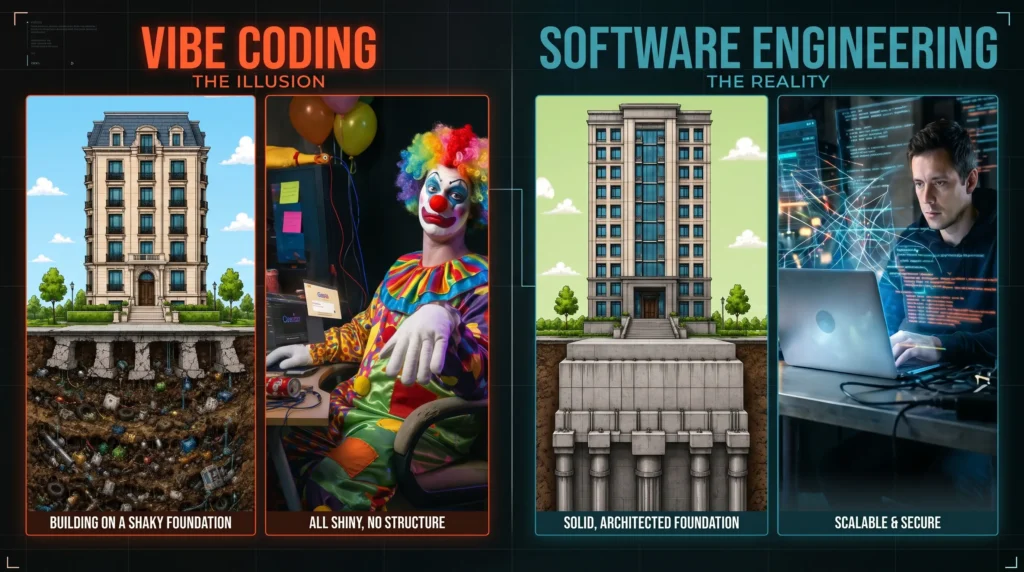
If traditional software development is carefully constructing a load-bearing skyscraper with blueprints, architectural reviews, and stress tests, Vibe Coding is slapping together a cardboard fort out of Amazon shipping boxes, spraying it with chrome paint, and charging $15/month for SaaS subscriptions.
It’s fast. It’s intoxicating. And it is completely tanking the software engineering industry.
The Apocalypse of Freelancing: A Race to the Ultimate Bottom
If you are a freelance developer who spent years mastering full-stack web development, backend API design, database normalization, and custom theme engineering, we have some phenomenal news for you: Your client just bought a $20/month AI subscription, and they are now your chief technical rival.
Here is how the freelancing landscape is currently disintegrating:
1. The “I Built 90% of It in 20 Minutes” Client
Freelancers used to get client briefs detailing business requirements, user roles, and target integrations. Now, clients come to freelancing platforms with a broken, half-baked codebase generated over a weekend of hyper-caffeinated prompt engineering.
The conversation goes like this:
Client: “I basically built the entire SaaS platform using Vibe Coding! I just need a quick developer to fix a tiny 10% issue where the database resets every time a user logs out and the payment gateway accidentally charges people in Icelandic króna.”
Freelancer: “Your state management is fundamentally broken, the database schema violates basic normalization, and there are three hardcoded API keys committed to the public repo.”
Client: “Okay, cool, so like… 2 hours of work? My budget is $30.”
2. The Inflation of Bloated Spaghetti Code
Because vibe coders don’t read the code generated for them, they have no idea that their simple contact form is importing four redundant UI libraries, three conflicting animation dependencies, and a 10MB WebGL bundle just to render a button hover effect.
Freelancers are no longer hired to architect clean systems; they are hired as digital plumbers to clear out massive logic blockages in codebases that nobody actually wrote.
3. The Death of Entry-Level Freelancing
Junior developers used to get their foot in the door by building straightforward landing pages, custom WordPress plugins, or basic e-commerce setups. Now, clients use LLMs to spit out front-end components instantly.
The catch? When those components inevitably break down at scale, the client has no idea why, the junior dev hasn’t built the core debugging muscle memory to fix it, and the senior dev is left staring into the abyss wondering why they didn’t pursue carpentry instead.
The Vibe Coding Tech Stack: Built on a House of Cards
To truly appreciate the vibe coder’s craftsmanship, one must look at their core development workflow:
- The IDE: An AI wrapper that automatically inserts 500 lines of unverified code every time you hit
Tab. - Database Architecture: A single, giant JSON file or an unindexed database table because schema migrations “ruin the vibe.”
- Security Layer: Pure, unadulterated hope. (Who needs environment variable sanitization when you can just hide your API keys deep inside
client/src/components/Footer.jsx?) - Testing: What testing? If it renders on localhost:3000, ship it to production!
The Impending Hangover
Vibe coding feels incredible right up until the exact moment your software encounters reality.
It feels great until your first hundred real users sign up and your unoptimized database queries lock the entire server. It feels amazing until a security researcher finds an unauthenticated endpoint exposed because your AI assistant forgot to implement access control logic in one of its 40 generated routes. It’s an absolute dream until you want to add a single customized feature, but the AI keeps rewriting the whole file and breaking three other dependencies in a catastrophic domino effect.
The truth about vibe coding is simple: Generating code is easy. Maintaining, scaling, securing, and debugging code is where actual engineering happens.
So to all the vibe coders out there building “10 micro-SaaS apps a week”—keep going! Ship those raw, unvetted components. Ignore technical debt. Never learn how a database index works.
Because when the entire house of cards inevitably collapses under the weight of real traffic, senior developers will be right here, charging double their hourly rate to clean up the vibes.